
Imagine being able to fly from San Francisco to Tokyo in just six hours. Or from New York to London in around 200 minutes? What about if it didn’t take an entire day (with a layover) to get out to Australia?
Over the last few decades, air travel has become increasingly accessible. It has opened up the world to more and more of us. However, a long-haul flight is still a significant undertaking. The idea of spending up to 18 hours on a plane can be daunting, and it isn’t something many of us would do more than once a year.
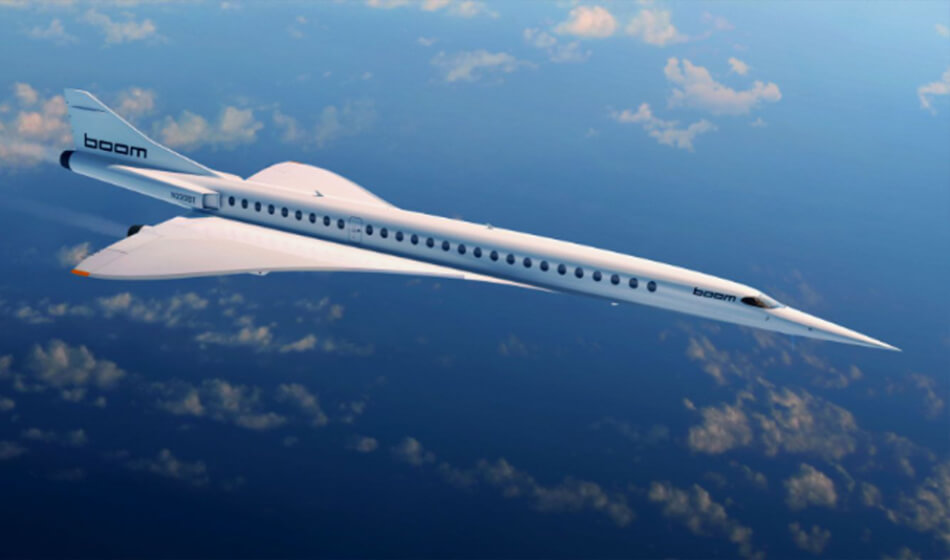
One trailblazing aerospace innovator is hoping to change all that. Boom Supersonic is a company that has its sights set firmly on redefining commercial air travel.
More. More. More.
Boom Supersonic has combined an aspirational vision with an inspirational approach. They want to make more parts of the world more accessible to more of its people. They say “When we fly twice as fast, cities rarely visited become major travel destinations. We can attend meetings in far-off places and return for evenings with loved ones. Global leaders can solve crises in person and children grow up in a world where nothing is foreign.”
Their ultimate goal is for people to be able to “Fly anywhere in the world in four hours, for $100”.
With such a bold, clear and ambitious vision, Boom’s strategy has been to inspire investors and attract attention within the industry.
Supersonic Sustainability
Boom Supersonic’s vision is backed up by truly innovative technology, which they believe will revolutionise the air travel industry. Their premium passenger airliner, the Overture, will be able to fly at twice the speed of today’s fastest commercial jets but, at a time when sustainability is key, they’ve developed their technology accordingly.
The Overture will attain its supersonic flight speed using fully sustainable aviation fuel (SAF). They claim that it will actually be the very first commercial aircraft with net-zero carbon emissions from day one.
A United Approach
With a crystal-clear vision, which promises industry-leading standards of speed and sustainability, Boom Supersonic has caught the eye of United Airlines. They have committed to buying 15 of Boom’s Overture airliners, with the option to take another 35 in the future.
The interesting thing to consider at this stage is that the Overture has not been completed or certified yet. Boom Supersonic has targeted 2029 for its first commercial flight so, for now, it is the company’s aspirational vision (backed up by science, and some robust KPIs, of course) that has captured the hearts and minds of United Airlines, among other investors.
It’s a vision that fits in neatly with that of United Airlines. Their motto reads, ‘Connecting People. Uniting The World.’
Boom! and United
United’s CEO, Scott Kirby, has made it his mission for the airline to become carbon neutral within the next 30 years, and the company has already invested in short-distance electric aircraft as well as carbon capture technology.
The move to add Boom Supersonic’s low-emission, supersonic jets to United’s plans marks a large step forward. It combines the company’s commitment to the planet with its commitment to its passengers. Upon announcing the agreement, Kirby said “Boom’s vision for the future of commercial aviation, combined with the industry’s most robust network in the world, will give business and leisure travellers access to a stellar flight experience.”
Redefining Air Travel
For a long time, innovations in air travel have focused primarily on passenger comfort. Airlines asked ‘how can we make the time in the air more enjoyable?’ rather than, ‘how do we reduce the amount of time we take to get there?’
As a result, many planes are now complete with bars, beds and private bathrooms. There’s no doubt that the First-Class services on many airlines have far exceeded what anyone could have expected in the early days of air travel.
But, despite the advancements in aerospace technology, companies have been reluctant to try and do what Boom has set out to achieve.
Elements of supersonic flight technology have been around for decades. From 1976, Concorde was able to fly people across the Atlantic at almost double the speed of sound. However, the plane had to be retired as it was expensive to run (and therefore very expensive to fly on), and it couldn’t fly over populous areas due to the sonic boom it created.
Despite their name, Boom Supersonic is committed to flying without the ‘boom’, while giving passengers more bang for their buck!
Another Giant Leap
When NASA first declared that they were going to put a man on the moon, there were many questions to be answered and many hurdles to overcome. Many thought it was impossible, but, in July 1969, the world looked on as two men made that first giant leap for mankind.
Most of the people watching that historic moment on TV would have never left their home country. Since then, the aviation industry has been playing catch up.
While it remains to be seen whether all of Boom’s goals are possible; it’s clear that they think it’s time for the next giant leap. And they seem to have no problem at all in expressing an aspirational vision to get everyone on board.